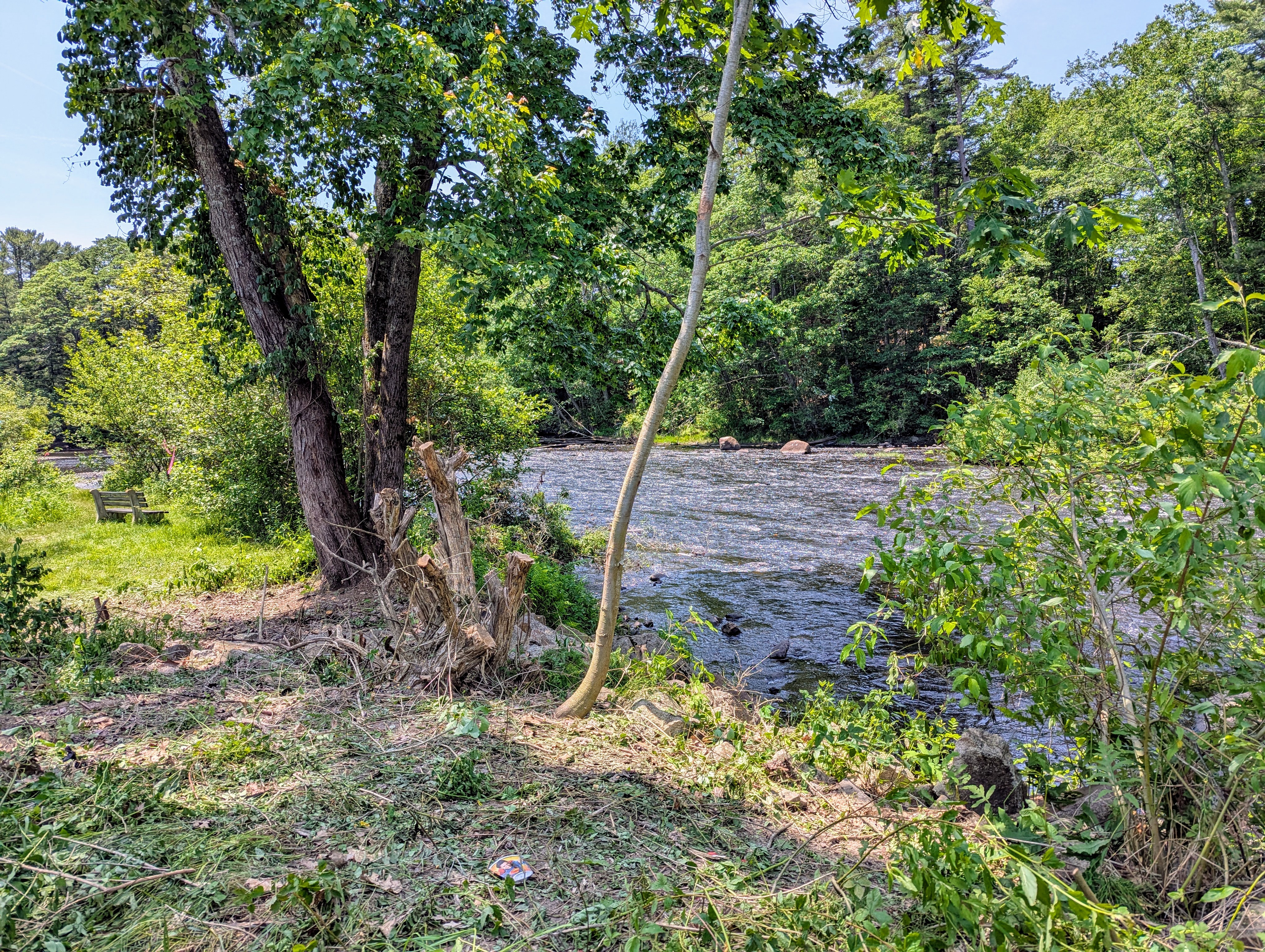
KENNEBUNK – Walking around Rogers Pond in early 2025 gave Kennebunk Conservation Committee member Lee Sullivan pause. Assessing the pond with plant biologist Shawn Jalbert and other committee members, Sullivan saw a pond overgrown with invasive plants and bushes, its lovely views of the Mousam River obscured by Japanese knotweed, honeysuckle and buckthorn.
“We were overwhelmed,” said Sullivan, who coordinated the KCC’s effort to tackle the plants at points along the Mousam River. “I just remember looking at those thickets and going, how in the world are we gonna ever get people in there?”
After groups of community volunteers showed up on two work days in June and September later that year to rip out invasives and plant native plants, Rogers Pond looked completely transformed. In all, 55 volunteers – including many Kennebunk High School seniors – joined in to help.
“We were pretty amazed,” Lee Sullivan said. “We couldn’t have done it without the community. We were just stunned and so gratified to see such a great turnout. . .to see so many people come out, all ages, you know, children, all up to grandparents and they really threw themselves into it.”
The town’s public works staffers hauled away truckloads of material and have since helped keep regrowth of invasives at bay by mowing down the “woodies” – invasives like knotweed, honeysuckle and multiflora rose.
“The town’s been very supportive; they’ve been absolutely great,” Sullivan said. “It’s made all the difference.”
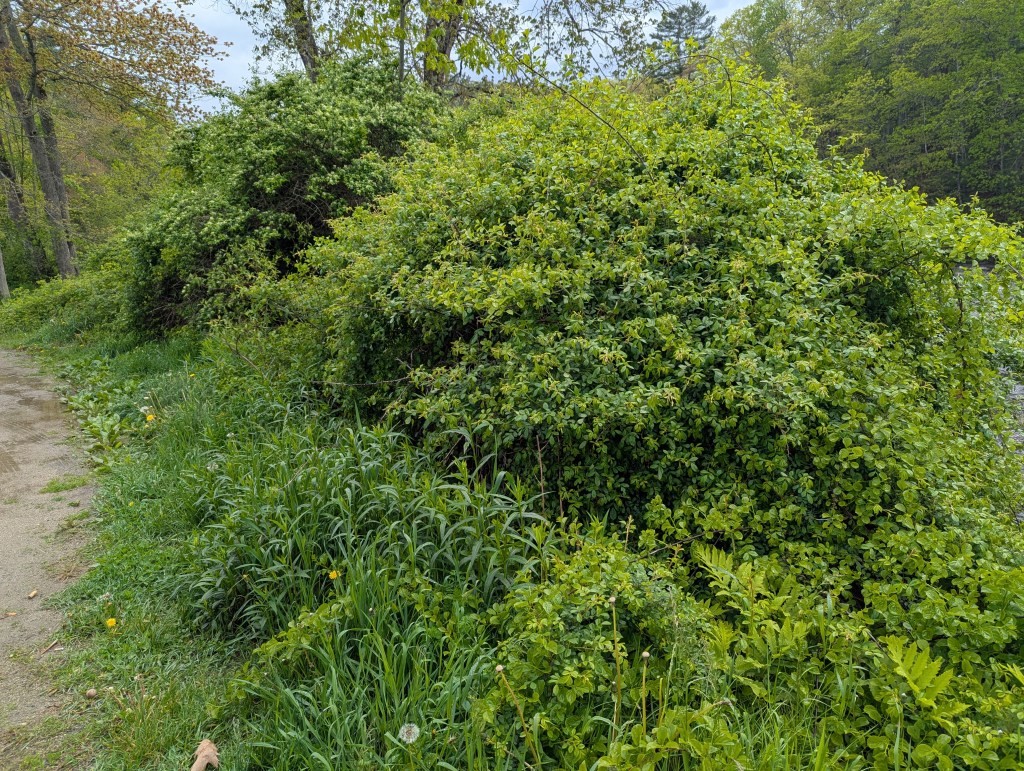
KCC Chair Jen Shack said the committee had decided to tackle invasives near Rogers Pond and Rotary Park two years ago.
“We’ve been wanting to educate the public about the importance of removing invasive species from their property and planting native species,” Shack said. “One of the big points of transmission [for invasives] is rivers, because they carry plant material and seeds down, and then they end up, you know, further afield. . . so we thought about the Mousam, and then we thought, oh, here are these two parks, which are full of invasives.”
In its public planning report and presentation last year to town officials, the committee explained the danger of aggressive invasive plants: by overwhelming natural habitats, invasives contribute to the decline of native species of birds and other wildlife. Since invasive plants have not evolved along with the wildlife of the region as native plants have, the invasives do not provide the food sources the native insects, birds and other native wildlife need.
Sullivan noted the importance of caterpillars, for instance, in raising baby birds: adult birds can eat bird seed, but most baby chicks need caterpillars to grow to adulthood – as many as 9,000 caterpillars per chick.
“What happens when you don’t have the trees and the plants to support the caterpillars?” Sullivan said. “So that’s where you get declining bird populations . . . we’ve lost something like billions of songbirds since 1970.”
The next KCC volunteer work day to continue clearing of invasives and planting native plants is planned for Saturday, September 19th, from 1pm – 3 pm at Rogers Pond. To join in, click on the volunteer signup link. No experience is necessary, all ages are welcome and training will be given on site.
The KCC says keeping Rogers Pond and Rotary Park free of invasives will require ongoing maintenance.
“It’s a two-pronged approach of removing the invasives and then seeing what naturally wants to be there: you know, what are the native plants that are already there, then probably supplementing that with some native plants to just make it really interesting and have educational signage labeling some of those plants and things like that,” Sullivan said.
Sullivan, who’s also a longtime member of The Southern Maine Invasive Plants Coalition, said there’s growing interest in the region and around the country in planting native plants that help the environment.
“I think people are waking up to, what are we doing in our yards? What are we planting?” Sullivan said. “Rogers Pond is such a great hands-on opportunity. . . we were doing it to get rid of the invasives and, you know, get the native plants to come back in, but once we cleared along the river, we were just astonished how beautiful it is. We were like, holy smokes, there’s a beautiful river here. I’m hoping that some of those people go to the park and get to, you know, feel proud of the work that they did.”
To sign up for the next Rogers Pond work day: https://bit.ly/Rogers_Pond