KENNEBUNK – Former real estate broker George Ford enjoyed serving as a greeter at the Kennebunk Bible Church. After a stroke two years ago, his ability to work and socialize grew more limited due to mobility and memory issues.
“I used to be great at remembering names,” Ford says. “That’s why they picked me to be the greeter. “My memory [now]? Totally gone.”
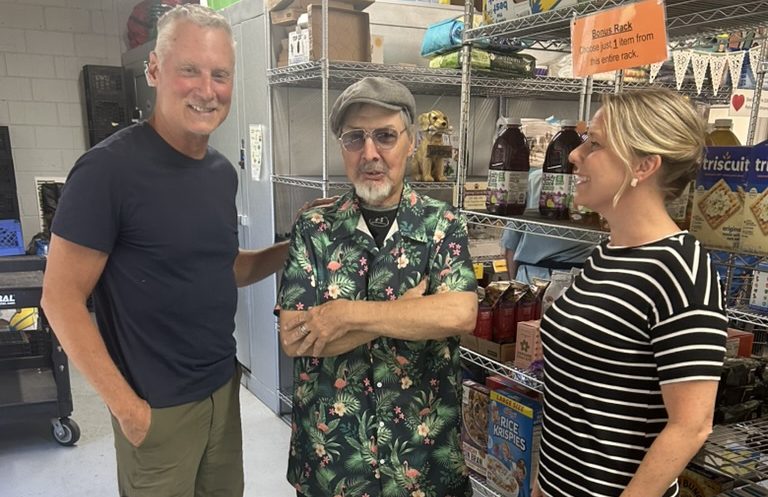
These days, Ford regularly visits the Community Outreach Services (COS) food pantry in Kennebunk, a short walk from his family home, for groceries. “This has been a godsend to me,” Ford says.
Community Outreach Service, celebrating its 35th year, served over 550 individuals in 281 households last year, with the help of over 100 volunteers and four staffers.
The food pantry’s primary donor partner is Good Shepherd Food Bank, which works with Hannaford stores to donate surplus or irregular food to COS: fruits and vegetables, dry and canned goods, and frozen meat.
“Sometimes, you know, we’ll get some canned goods that might be slightly dented,” Executive Director Mark Jago said. “We’ll get deli products, foods that are prepared, either they’re getting near their expiration day or they want to make room on their shelves for another product.”
COS volunteers, working in pairs, pick up food deliveries from Hannaford four days a week, transporting them according to safety protocols and maintaining temperature as needed with insulated blankets and bins before delivering them safely to the food pantry’s shelves or walk-in refrigerators.
It falls to David Higham, Food Programs Director, to take stock of each day’s donation. Higham says COS never knows what kind of food they will get.
“My job is to try to make sure there’s always food here,” Higham says. “It’s like running a grocery store based on whatever shows up that day.”
Volunteers sort the delivered items and shelve them along COS’ food aisles, set up supermarket-style, with clear labels.
Some irregular items require work from volunteers to prepare for sale. A recent Hannaford delivery included sets of three cucumbers wrapped in plastic, with some cucumbers starting to show signs of decay. Volunteers opened each individual package to sort salvageable produce from the rest.
For key grocery items that don’t show up in donations, Higham places a delivery order with Good Shepherd once a month, which might range from 2,000 to 4,000 pounds of food. Good Shepherd sells these items to COS at a discount of 15 percent off the wholesale price.
Other partners in the area that donate or sell food to COS at a discount include Shields Meats and Produce, for meats and dairy products; area farms including Arundel’s Frinklepod Farm, for produce; and Kennebunk’s Boulangerie bakery, for bread. Community gardens such as the West Kennebunk and Park Street community gardens contribute produce, and other area residents occasionally donate surplus vegetables from backyard gardens as well.
COS’ 108 volunteers work in shifts of no more than one per week, and no more than two-and-a-half hours maximum, to avoid burnout. Jago interviews each prospective volunteer to make sure they are suited to their specific role and have the right mindset.
“You know, you’re assisting our neighbors, so we look for people that have personalities that are social-minded, friendly, and welcoming,” Jago said. He believes this respect for volunteers’ time and abilities is the reason COS is blessed with volunteers.
“We have so many volunteers, because they like coming here. They know exactly what they’re intended to do, what’s expected of them, and the length of time. So they begin to commit themselves on a weekly basis…they’re also building relationships and friendships, which a lot of folks are looking for.”
Jago, who has volunteered with COS and served as its Executive Director since 2018, is the food pantry’s sole full-time paid staffer. Apart from Jago, three part-time staffers include Jago’s assistant, Stephanie Hatfield, Food Programs Director David Higham, and a volunteer scheduler, Roe Mignogna.
About half of COS’ food is purchased, and half is donated; the total value of food distributions in 2025 was about $360,000. COS primarily meets its annual costs through individual donor contributions and foundation grants.
The roughly 110 households served by the food pantry each week also appreciate the occasional unusual food offerings provided from community food drives – ground coffee, or sparkling cider, for instance. COS also frequently shares surplus goods with smaller pantries in the area, usually those in Alfred and Biddeford, which has a larger unhoused community and higher food needs than COS’ service area of Kennebunk, Kennebunkport, and Arundel. Recently, Jago got a call from a truck that found a supermarket order mistake had been made, with about 2,000 jars of grape jam delivered instead of grape juice. Jago reached out to the Alfred and Biddeford food pantries to share the surplus jars.
“The bigger picture is, we’re here not just for the food insecurity of our neighbors, but neighbors in the broader community,” Jago said.
In addition to picking up donations and sorting food for the pantry, volunteers serve as personal shoppers, helping visitors (referred to by COS as neighbors) select items from among the pantry’s aisles.
Stephanie Hatfield says the ability for neighbors to select their own food items rather than being handed a miscellaneous bag of food provides them with dignity.
“They can make choices; they aren’t just handed something. Not that there’s anything wrong with that, that is a way to help people. . . we’re lucky we can go a few steps further with that, and give them some dignity, and a good choice. They can make some of their own selections, hopefully with some encouragement, and with interpersonal interactions as well.”
Hatfield notes there is a trend of rising food insecurity in the community at large.
“More and more people are finding themselves needing help that have never needed it before,” Hatfield says. “Probably one of the most common things I hear is, I never thought I would need help with food. Hands down, one of the most common things I hear: ‘I used to be someone who helped in organizations like yours.’ “
Neighbors in need of pantry items are not required to show income qualifications; they only need to make an appointment in advance, and to fill out a contact form. While COS won’t turn anyone away from outside the three service towns, volunteers will let visitors from outside the service area know where they can access food banks in their region in the future, as the pantry is primarily for those who live in the service area.
“Right now, we’re getting a lot of seasonal workers that are coming from other countries that work in restaurants, campgrounds in the area,” Jago said. “It can increase in the summertime.” Seasonal workers from other countries include those from Jamaica, Honduras, and the Dominican Republic.
In addition to food, COS also meets needs related to non-food items on a case-by-case basis, including covering fuel for neighbors who need it, helping pay for electrical bills or key home repairs, or occasionally covering an evening at an area hotel, where those in need can have a hot shower.
A new section in the COS aisles is pet food and treats, added once volunteers noticed neighbors who visited the food pantry were forgoing food for themselves in order to feed their pets.
George Ford doesn’t have a dog of his own anymore. He enjoys sitting with a cup of coffee and a bag of dog treats on a bench outside his home that he built himself in earlier days, sharing the treats with passing neighborhood dogs.
“According to the dogs, I’m the most popular guy,” Ford said. “I get the biggest kick out of seeing those tails wagging. I can’t remember the dog’s name, or the owner’s name, but they’ll remember you. Dogs always remember. That’s what’s so great about them.”