KENNEBUNK — Voters on Nov. 3 will decide whether to change the section of the town charter that governs recall elections, including increasing the number of signatures needed to initiate a recall and establishing specific grounds for removing an elected official.
The Kennebunk Select Board on September 8 voted 6-0, with one member absent, to place the question on the ballot and recommend its approval. The vote followed a public hearing at which no one spoke on the proposal.
The proposed changes follow a divisive recall effort in 2022 that targeted two members of the Regional School Unit 21 Board of Directors. The experience prompted a broader review of Kennebunk’s charter, but voters rejected a proposed overhaul of the document in 2024.
Now, the ballot question would revise the recall provisions alone.
Miriam Whitehouse, chair of the select board, said she could not speak on the matter in her official capacity because board members are not allowed to try to influence elections. Speaking as a resident, however, she said the division surrounding the last recall election was a major reason she supports the changes.
“The main driving force for me was to try to avoid ever having to go through such a painful community experience again,” Whitehouse said, referring to the 2022 recall effort.
Under the proposed changes to Article VII of the charter, a recall effort would begin with a petition signed by 50 registered voters, up from the 25 currently required. The petition’s agent would then have to collect additional signatures from registered voters equal to 10% of the number of people who voted in the most recent gubernatorial election.
In the last gubernatorial election, held in 2022, the vote count was 6,650, Kennebunk Town Clerk Merton Brown said. He is projecting 7,000 voters for the Nov. 3 election, meaning 700 signatures would be needed to start a future recall petition.
The proposed change also would require at least 3,000 people to vote in order for the recall election to be valid. The June 2026 elections would have met the 3,000-voter hurdle, but the special election in March 2022, in which 2,232 people cast votes, would not have.
The proposal also would require the filing of an affidavit detailing the allegations underlying the recall effort.
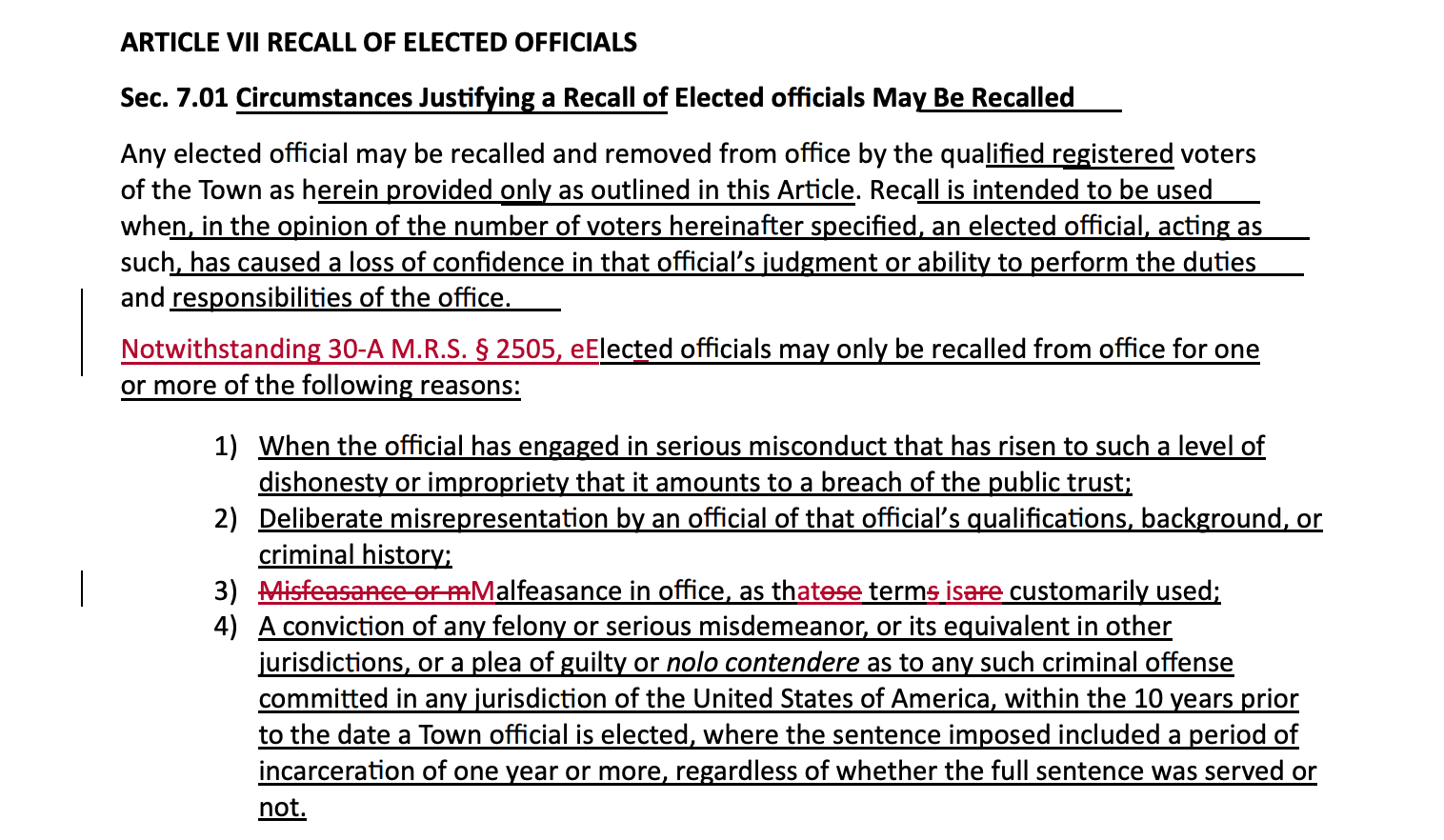
The current charter allows a recall when voters determine that an elected official “has caused a loss of confidence in that official’s judgment or ability to perform the duties and responsibilities of the office.”
The proposed revision would establish four specific grounds for recall:
- Serious misconduct such as dishonesty or impropriety that amounts to a breach of the public trust.
- Deliberate misrepresentation about qualifications, background or criminal history.
- Misfeasance or malfeasance in office.
- A conviction of a felony or misdemeanor or a plea of guilty or nolo contendere in the American justice system in the 10 years before being elected if that carried a sentence of incarceration of one year or more.
The proposal also would change how the replacement for a recalled official is selected.
A divisive recall effort
In 2022, Kennebunk voters overwhelmingly rejected a recall effort against Timothy Stentiford, a member of the RSU 21 Board of Directors. The vote was 516 in favor of the recall and 1,716 opposed.
Community members also sought to recall another board member, Art LeBlanc, but election officials did not verify enough signatures to put that recall before voters.
Supporters of the recalls argued that the board members should be removed because of their roles in increased administrative spending and negotiations over a teachers’ contract that they said contributed to staff losses. The actions had caused them to lose confidence in the members, according to the recall documents.
The contentious recall effort led voters to approve the formation of a six-member Kennebunk Charter Commission on Nov. 8, 2022.
The commission submitted its final report and a proposed new town charter to the select board in 2024. Among its recommendations was changing Kennebunk’s form of government from a select board to a town council.
Under the proposed structure, the town council would have assumed responsibility for approving ordinances, while voters would have retained control over budget approvals and municipal borrowing. The commission also recommended restricting the grounds for recall and increasing the number of signatures required to initiate the process.
A minority report written by two commission members argued for retaining the traditional select board structure, calling the proposed town council model “an unnecessary and unacceptable transfer of power.”
Voters rejected the proposed charter revision on Nov. 5, 2024, with 35% voting in favor and 65% opposed.
Debate over partial revision
Some residents feel citizens should not be be asked to vote on one section of the charter after voters previously rejected a comprehensive revision that included changing the recall process.
Rewriting one section of the charter is “out of line with the spirit of the state law,” said Chris Cluff, a former Kennebunk resident who served on the charter commission.
“Especially since this is almost exactly what the charter commission proposed and was voted down overwhelmingly by voters,” he said. “The select board is overreaching here.”
At a June 23 workshop, Whitehouse asked town attorney Ben McCall of Drummond Woodsum whether Kennebunk could amend just one article of its charter. He said the proposed changes to the recall process would qualify as an amendment, which voters could approve at the ballot box without forming a charter commission.
“This has been sort of a million-dollar question in municipal law in Maine for quite some time,” McCall said.
The attorney said the Maine Supreme Judicial Court recently offered an opinion that distinguishes between amendments, which make limited changes to an existing charter without altering the fundamental nature of government, and revisions, which involve more substantial changes, such as switching from a select board to a town council. A charter commission would only be needed for a revision, he said.
Ted Trainer, another charter commission member, supports revisiting the recall provisions and approving the new charter change. He said a quick read on the proposed changes convinced him that they build on the commission’s work and that the recall issue was the reason the commission was established in the first place.
“The reason the (charter commission) report went down had nothing to do with this recall issue; rather the form of government in Kennebunk: town council vs. select board,” Trainer said.
Kennebunk resident John Costin also sees no problem with asking voters to consider the recall provisions separately, calling it a “minor revision.” Costin supports the proposed changes, citing the 2022 recall effort as evidence that the existing process needs tighter safeguards.
“It turned out to be a little too easy to move that towards the ballot,” he said. “We’ve learned now that there should be some kind of ‘truth test’ for things that are put before the voters, and the charter did leave that open.”
Kennebunk resident Melissa McCue-McGrath opposes the change on the grounds it makes it more difficult to recall an elected official.
“I don’t think we should be making things harder for our community to have a vote on an official who the community has lost faith in,” she said.
She opposes doubling the number of signatures for a recall petition from 25 to 50 and requiring that at least 3,000 people vote for the election to be valid.
“I think by making it harder, it’s only protecting the people who are being elected,” she said. “The voters need to be taken a little bit more seriously and we need to stop putting hurdles in our way so that what limited ways we have to have a say in our government aren’t made harder.”
McCall, the town attorney, said by law charter amendments must be voted on by at least 30% of the number of voters who voted in the last gubernatorial election. Many towns are putting amendments before voters because this November’s election is expected to have a turnout that meets the 30% threshold, he said.
— Carol Morris and Susan Bloomfield contributed to this story.