Contributed by Stephen Ingraham
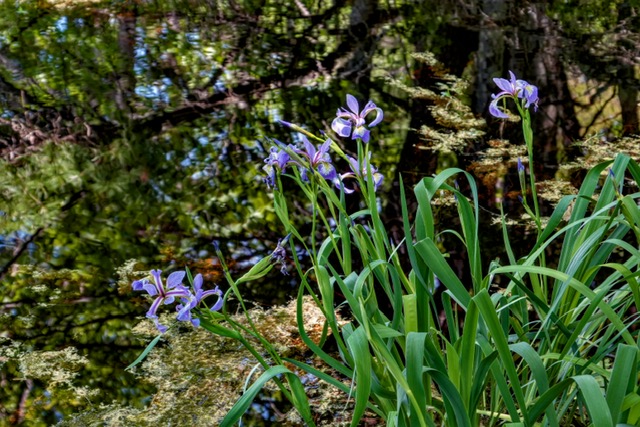
June, in my mind (and heart), is purplish blue with highlights—oh, I know it should be bright green with the emerging leaves and the leaping ferns—but it is the season of the lupine and wild iris (sometimes called blue flag iris), and those two flowers color the whole month for me.
Miss Rumphius, written and illustrated by Barbara Cooney, was a favorite in our house when the children were young (they called it “lupine lady”), and I have always been tempted to find even a small way, as Miss Rumphius did, to leave the world a little more beautiful than when I came. I cannot look at a field of lupines without feeling thankful to whoever lets them grow—whoever is that motivated to let the world be beautiful.
It is not, of course, as simple as that—nothing is. The lupines we love here in Maine are not native to the state. They were introduced from the Northwest Coast as garden plants in the late 1800s and very early 1900s (the beginning of Miss Rumphius’ time) and began to spread. The mass displays we see today in fields and along roadsides did not really begin to develop until the 1950s (as near as I can find). We do have a native Maine lupine, the Sundial Lupine, but it has all but vanished from the state, and along with it, the Karner Blue butterfly that depends on it as a host plant. And the big Leaf Lupine competes directly with our native Milkweed, with definite effects on the Monarch population. So beauty, as always, is in the eye of the beholder. There are those who are passionate about eliminating Big Leaf Lupine from the state altogether.

I have no such qualms about the Blue Flag Iris. Purple-blue, generally with a patch of bright yellow on the outer fluted petals—it impresses more close-up—individual flowers rather than the mass displays of lupine. It grows where water meets soil—at pond edges, in ditches, along the edge of fresh-water marshes. It likes to have wet feet, and rarely will you find a stand actually growing in water. The flowers do not last more than a day or two, but the cluster can flower for a week or more, and since it grows from rhizomes, the cluster spreads underground year to year. Still, the season is brief, and it is best to catch them when you can. Just pay attention to the passing ditches as you drive, the low spots in wet meadows, and check the edge of any pond or slow-moving stream.

A field of lupines is a shout of beauty. (To some.)
A stand of iris is a simple melody by the water’s edge that takes you by surprise.
I am not making any judgement here: both the lupine and iris are currently part of the color of my Maine June, and I would not willingly surrender either. It does make me think though—if I ever do find a way to contribute to the beauty of the world, it might be closer to preserving the beauty into which I was born.