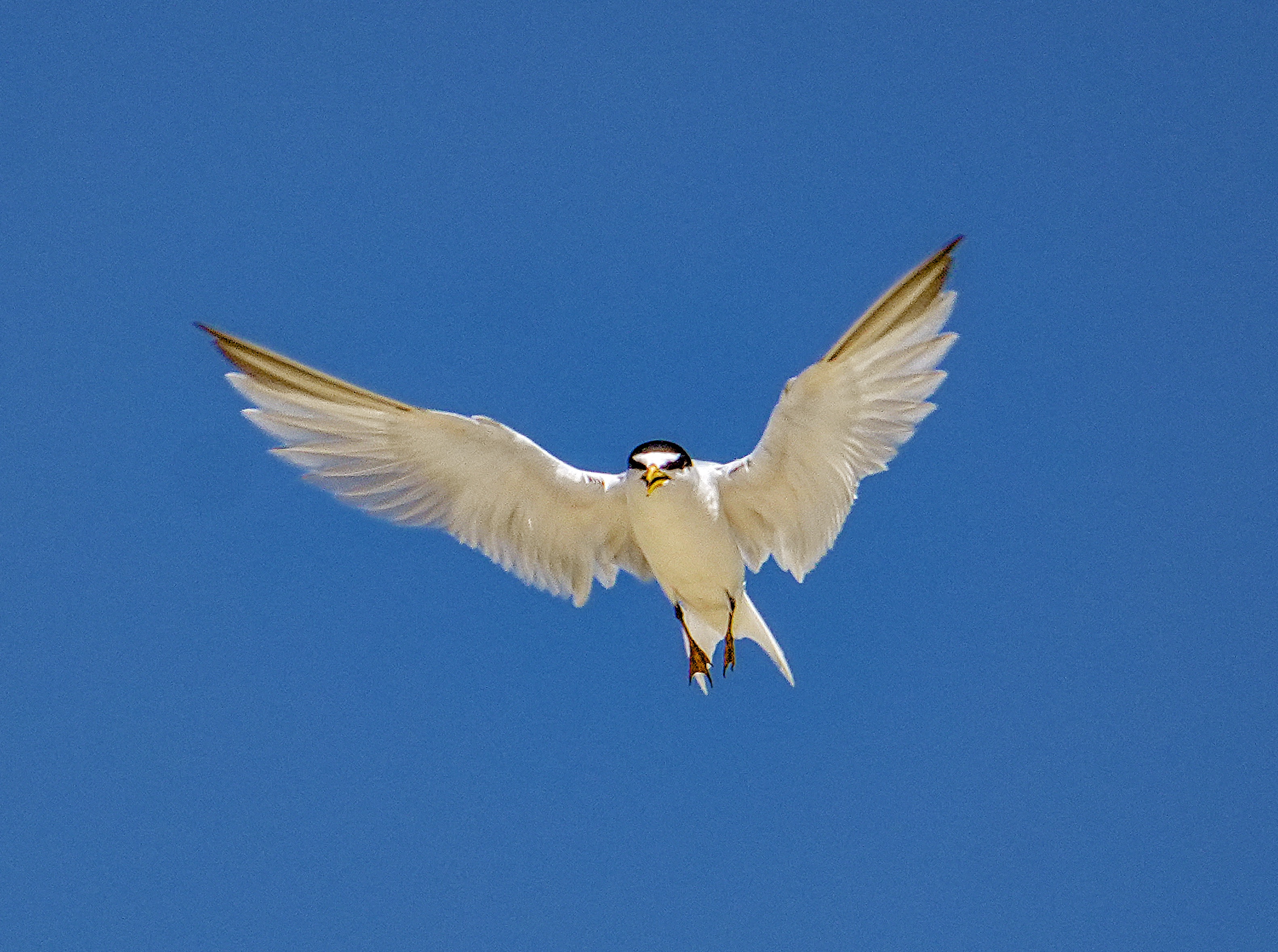
Contributed by Stephen Ingraham, Kennebunk
For the past three years, the endangered Least Tern has graced at least one beach in Kennebunk. Though it is a beach with limited access, it is still, even in June and July, well populated with humans—popular with sunbathers, fishermen, and dog-walkers. If you visit, you can’t miss the Terns. Even if you stay well away from the protected nesting area (which you should do), they will use you for target practice, coming in at eye level, swooping up at the last moment, and releasing a load of guano to decorate your hat—or face if you are not wearing a hat. Of course, they are actually displaying their aggressive drive to protect their nests and their eggs—and their future as a species. They just have not quite figured out that the humans who visit the beach, especially walkers, are not a threat to their eggs.
Considering that the Least Tern was almost completely wiped out by the millinery trade in the late 1800s, and has taken all of the 20th century to recover and begin to recolonize the ever-changing mosaic of beaches that were its traditional territory—and that it is still here in early days of the 21st century—on the brink of survival as a species—you might be able to forgive their aggression, even when they make a direct hit.
And here’s a tip: If you want the birds to leave you alone—sit down, sit still, read a book, watch the waves. You will soon become part of the scenery as far as the birds are concerned. And don’t wear a hat. They do not like hats—or perhaps see them as larger targets. And don’t point a camera at them. I am pretty sure they see the lens as one huge eye sizing up their eggs.

Of course, I do point my camera at them. The simple challenge of catching a bird so fast, so agile, so elegant, in flight—at eye level or hovering overhead—is too much for any nature photographer to resist. I stay well away from the protected nesting areas, and I still have hats that testify to their instinctive need to protect—and their accuracy—and I never go out without wet wipes for my face and camera.
And I have to suspect that it is no accident that they are successfully nesting on a busy beach. I think they have learned that human traffic (including our dogs) provides a defense against their natural predators—gulls, pigeons, foxes, skunks, raccoons, etc.—without the loss of any extra eggs. They are actually safer on a moderately populated beach than they are on a wild beach. As long, of course, as we humans respect the protected areas up near the crest of the dunes (roped off and signed), and keep our dogs on leash and well away.
You might suspect, as I do, that in tough times for the species, they are willing to use all the help they can get.
And it makes me feel hopeful, somehow, to think that we and terns, or at least the terns and I, are discovering our mutual advantage—developing a relationship that is not exploitative on either side. I am willing to share a beach I will never own with them, if they are willing to share their lives with me.
And who, honestly, would want to risk facing another century of Junes and Julys in Kennebunk, where the sky is not filled with the cries and aerial acrobatics of the Least Tern?